ConArte - Training programme for Trainers
1. Training of Trainers Programme
In Mexico, public schools and communities face challenges derived from social inequality, structural violence and the lack of recognition of diversity, which directly impact on the well-being and integral development of children, youth and adults. There is a lack of teacher training and methodologies, tools and strategies that have been sufficiently studied, researched and systematised, that are flexible enough to adapt to the specific contexts of each place, as well as to diversity and a gender equity approach. Faced with this reality, ConArte recognises that art education is an essential means for the development of creative and expressive skills, self-knowledge, socio-emotional development, inclusion and a culture of peace. By strengthening artistic and pedagogical training, conflict mediation and reparation skills for teachers, public servants or relevant agents in group dynamics and community interaction, it contributes to improving environments, expanding learning possibilities and building more empathetic and collaborative communities, capable of self-regulation and creating common futures. In this way, the project responds to the urgent need to reintegrate sensitivity, listening, creativity and collaborative coexistence in everyday life, it promotes the exercise of cultural rights, not only as equitable access to the enjoyment of art, but also to live and participate in transformative aesthetic experiences that, in turn, teachers, institutions, organisations and communities in general can replicate, implement and adapt in a sustainable and autonomous way, becoming agents of cultural change. The Training Programme for Trainers promotes capacity building to make arts education a reality in schools and communities. We work with artists and classroom teachers from all over the country and from other countries where ConArte has promoted collaborative processes. We facilitate the incorporation of art into the practice and experience of those interested in doing so. We also encourage the creation of new knowledge, experiences, skills and resources among and for teachers and artists interested in collaborating with public schools, arts training centres, community centres and public spaces. Similarly, this programme supports the emergence of new non-school-based arts training centres throughout the country and the transformation of school environments through the arts and critical and intercultural pedagogies.
Training Programme for Trainers addresses two key axes: The first is training in methodologies focused on art education in school classroom spaces. The second is training in methodologies for a culture of peace, security and social welfare for civil servants or agents of change that can influence working groups or communities.
2. Goals and project implementation
2.1. Main aim and specific goals
- To train artists, managers, activists, civil servants, teachers, community leaders or agents of change who have an impact on their communities, educational and training spaces at any level, in public spaces, autonomous organisations and even centralised organisations, using one of the thirteen methodologies developed by ConArte.
- To consolidate an educational and cultural strategy that recognises art as a means to transform, imagine and build community, accompanying teachers in the task of training trainers who contribute to guaranteeing new generations that are creative, expressive and supportive.
- To train and accompany agents of change or people in charge of working groups in violence-free processes through comprehensive training in diversity, gender perspective, social inclusion and culture of peace, applicable to schools, work environment, cultural mediation and/or citizen security, promoting spaces of encounter, expression and wellbeing with their community and work teams.
- To support the role of cultural agents within the communities where they work, promoting, training or reinforcing the tools and knowledge previously acquired by teachers or agents of change under one of the thirteen methodologies, strengthening their capacity to integrate the body, movement, listening and emotion into their practice with the community.
The specific goals are:
- Advocating using one of the 13 methodologies offered by ConArte in at least 5 of the 32 states of the Mexican Republic by 2027.
- Increasing the percentage of creative resources for teachers in classrooms, communities and public spaces, improving attention, listening and participation.
- Consolidating qualitative and quantitative processes that allow artistic methodologies to be formally integrated in plans and programmes.
- Building certification links for cultural agents, teachers or staff who are trained and qualified in any of the 13 methodologies offered by ConArte within the Training Programme for Trainers.
The programme promotes capacity-building to make arts education a reality in schools and communities.
2.2. Development of the project
ConArte has developed 13 methodologies that integrate art education to strengthen formal and non-formal education, coexistence and community transformation. The processes consist of cross-cutting training in culture of peace and methodological practices, whether through dance, music, visual arts, graphics or performing arts. Through intercultural and interdisciplinary workshops and community interactions, we provide trainers and teachers with tools to find creative solutions to contemporary problems and conflicts through social participation. Using methods that engage the physical, emotional and cognitive, we ground concepts, strategies and tools for healthy coexistence. We train artists, teachers, public servants, police officers and other community members in empathetic pedagogies and innovative techniques so that they can sustain processes in their localities autonomously.
Education in the Arts - Training of Trainers
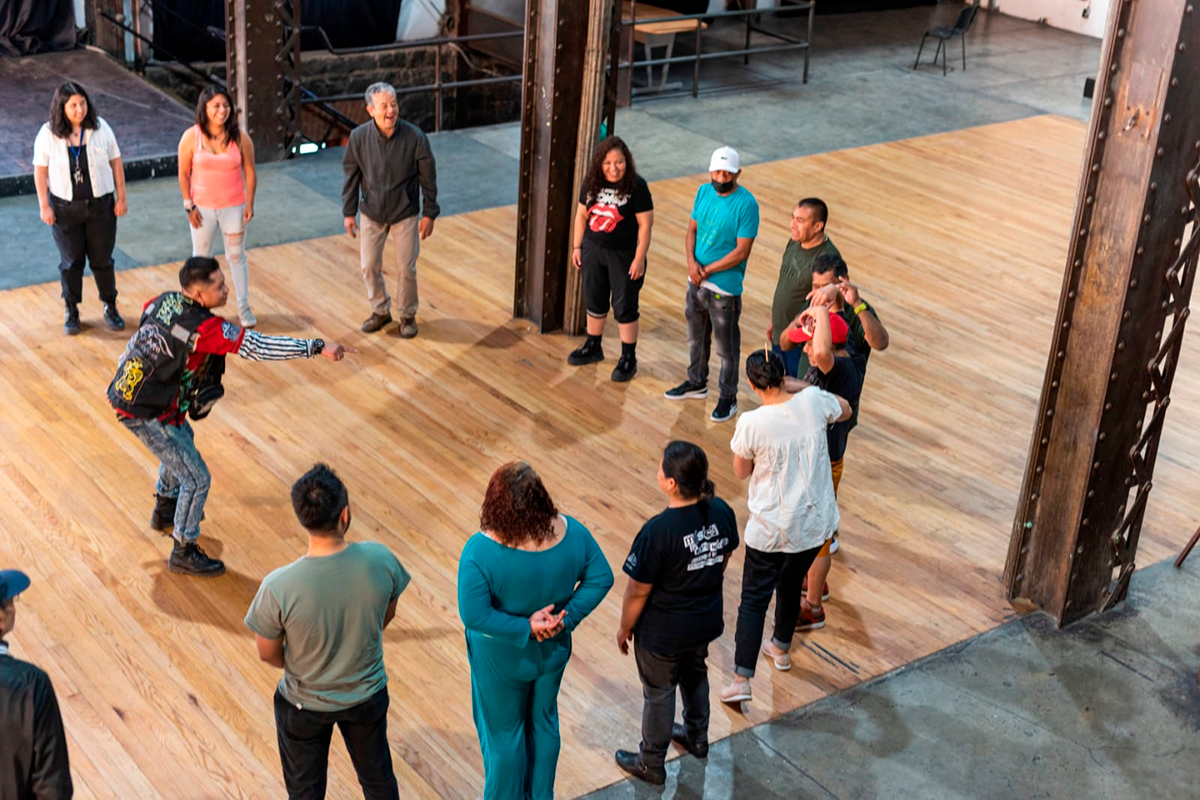
It is developed through an experiential process in which professional and non-professional artists, together with primary school teachers, explore different artistic languages as pedagogical tools that strengthen teaching, expression and school coexistence. The process is organised in three blocks:
1. Teacher training
Teachers participate in theoretical and practical courses led by one to three artist facilitators invited by ConArte. These methodologies focus on initial artistic and pedagogical processes, especially aimed at children and adolescents, and participants are provided with theoretical material on one of the following methodologies:
- Learning with Dance: integrates movement, emotion and body into learning.
- Ah, what a song!: encourages collaboration through the creation of choirs.
- Escenificarte: uses theatre as a means of integration, reflection and socio-emotional development.
- Musical games: introduces music theory and practice in a playful way.
- Body percussion: stimulates active listening, coordination and collaboration.
- Musical groups and ensembles: individual and collective instrumental learning to encourage teamwork and coordination.
- Fusion Roots: explores compositions that connect tradition, contemporaneity and technology.
- Visualizarte: encourages sensitive and collaborative practice through drawing, painting, photography and video.
- Urbedanza: invites you to rediscover the school and urban space as a creative stage.
Each session combines body dynamics, sensorial exercises, improvisation, collective reflection and the design of didactic resources, favouring access and relevance over strict and absolute professionalisation.
2. Group follow-up
The trainers of trainers visit schools or communities to advise artist-teachers on the implementation of methodologies, adapting them to the context and encouraging the participation of all those involved.
3. Presentation to the community
The process concludes with performances, visual interventions or collective actions that strengthen the sense of belonging, the feeling of agency, inter-institutional collaboration and the recognition of artistic practice as a cultural right.
Security and Social Welfare - Training of Trainers
Work is carried out directly with the communities in coordination with public or private bodies, promoting safety, inclusion and social cohesion through artistic and participatory methodologies in four phases:
1. Research: the situation and/or problem to be addressed is analysed through quantitative and qualitative data, documents and field research to identify the root causes.
2. Proposal: based on the participatory diagnosis, the methodology is defined, activities, timelines, budgets and expected results are designed.
3. Training: workshops conducted by specialists (interculturalists, dance therapists, community psychologists and experts in other areas) who promote positive changes. They include the following methodologies:
- Dance for coexistence: with techniques for diverse groups and people with disabilities.
- Recovery of public spaces: community appropriation of risk areas with a gender, safety and inclusion perspective.
- Community mural: collective creation to redefine the meaning of public spaces.
- Social reintegration: to integrate former prisoners into communities
4. Monitoring and results: the results obtained are analysed and delivered, guaranteeing an improvement in the community. Testimonials are gathered and qualitative and quantitative evaluations are implemented, along with the preparation of reports and material that accounts for the work carried out by ConArte in collaboration with the local authority. Finally, a follow-up is scheduled with specialists of the methodology implemented in the sector served, to ensure that the community agents are implementing their training in the best possible way.
Together, both axes promote sensitive, playful and transformative pedagogical, artistic and community practices. Art becomes a means of learning, coexistence and integral development, strengthening educational and social communities where the Programme is present.
3. Impacts
3.1. Direct impacts
By systematising its programmes, ConArte has managed to consolidate and sustain the validity of the initiatives it offers, enabling it to make them available to both the public and private sectors. Specifically, the Training Programme for Trainers started in 2006 in partnership with the National Dance Institute of New York, and since then has remained active through alliances and management with secretariats in several states of the Mexican Republic, civil society organisations, universities and communities. In short, the good practices and results obtained by the methodologies in benefiting a growing number of communities have ensured that the programme continues to develop in more than 20 states of the Republic and countless communities.
The active participation of the communities has helped to multiply the impact: for every teacher, cultural agent, public official or artist trained, dozens of students and communities have access to artistic and culture of peace experiences that enrich their integral development and access to their human rights.
The Training Programme for Trainers has forged links between ConArte and local, regional, state and communities’ organisations, consolidating itself as an effective strategy to transform environments through training in methodologies that integrate intercultural tools for diagnosis, planning and development.
We carry out proposals that respond to individual needs with our own methodologies, and in collaboration with other organisations and collectives in Mexico City, in various states of the Republic and in other countries in Latin America, the United States, Africa and Europe.
This programme trains in methodologies both for art education in schools classroom spaces, and for a culture of peace, security and social welfare for civil servants or agents of change that can influence working groups or communities.
Among the observations are:
- The initiative has contributed to the consolidation of collaborative networks between teachers, artists and public officials. These networks strengthen the sense of belonging and the exercise of cultural rights, promoting art as a means to build peace and social well-being.
- Creation of spaces for coexistence and collective recognition through artistic exhibitions, murals and stage performances.
- Thousands of artists, teachers, cultural agents, public officials and community leaders trained in one of the thirteen ConArte methodologies in more than half of the national territory.
The impact of the Training Programme for Trainers is reflected both in its scope and in the human and pedagogical quality of the processes. Beyond the transmission of knowledge, the initiative promotes lasting transformations in the ways of teaching, learning and living together in workplaces and communities, contributing to the reconstruction of the social fabric.
3.2. Evaluation
The initiative has trained nearly 18,000 trainers in experiential processes throughout the country. Around 500,000 children are indirectly benefited through activities implemented in classrooms, communities or public spaces throughout the country.
The main achievement of the initiative lies in transforming the meaning of teaching, providing specific and methodological training for art education in contexts of violence. Trainers report that they have found meaning, regained motivation, creativity and the sensitivity necessary to create a more empathetic, sensitive and participatory environment with their groups.
3.3. Key factors
- Interdisciplinary methodologies.
- Pedagogies based on artistic languages.
- Common core of intercultural tools and culture of peace.
- Pedagogical structures adaptable to different levels of knowledge and learning.
- Tools that incorporate the cultural diversity of participants.
- Collaborative strategies that allow to bring together expressions based on the collaboration of people at different stages of the learning process.
- Gender approaches applied to everyday life situations and the use of public space.
- Open calls for the participation of people with and without pedagogical experience, based on collaborative strategies.
- Collective processes of artistic knowledge production.
- Own methodologies developed from the contexts in which we work.
- Approaches for community appropriation of public spaces with a gender perspective.
- Methodologies applicable to spaces for collaboration between people working in education, culture, public safety, urban development and health.
- Recognition of the ethics and commitment of ConArte’s trainers of trainers.
- National and international recognition. ConArte Mexico is the origin of ConArte International, based in Girona.
- Co-creation and co-production strategies in schools and public spaces.
3.4. Continuity
The purpose of the Training Programme for Trainers is to contribute to the autonomous construction of more humane, sensitive and creative communities, where art is a right and an everyday tool for learning, teaching and living together in peace.
To guarantee the continuity of the programme, we seek to consolidate a network of teacher trainers, which acts as a multiplier in different areas of Mexico City, the country, and the region. To deepen support in the classroom and community, incorporating digital monitoring and accessible teaching resources. To expand coverage to new educational levels and communities, strengthening cultural equity. Finally, to systematise, disseminate and certify successful experiences, strengthening art education as a public policy for transformation.
4. Further information
This article was written by María Fernanda Espitia Sánchez, Outreach Coordinator at ConArte, Mexico City. The photographs that appear in this good practice are the property of ConArte.
Contact: procuracionfondos.conartemx (at) gmail.com
Website: www.conartemx.net
Social Networks: @ConArteMexico