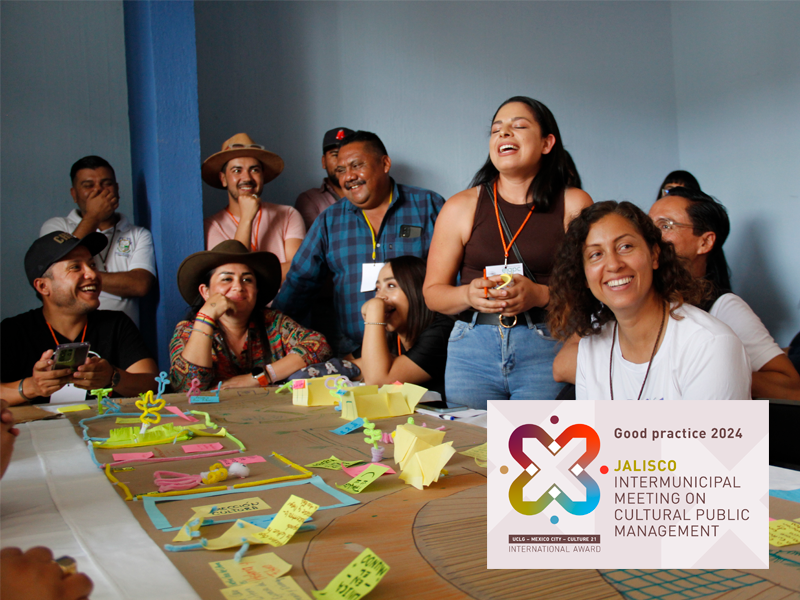
Intermunicipal meeting on cultural public management (EIGPC)
1. Jalisco and culture
Jalisco is home to a culturally diverse population of more than 8 million inhabitants, 51.2% residing in the Metropolitan Area of Guadalajara (AMG), composed of 9 conurbate municipalities, and the rest distributed across the 116 municipalities of the interior. Among other things, its rural areas face challenges such as the “spectacularisation” of the cultural agenda, the lack of clarity in the competences between the Directorates and Councils of Culture, and the political and civil expectation that sees the cultural area of the City Council as the office whose sole task is to organise local festivities. Likewise, an occasional lack of interest shown by municipal governments, budgetary constraints and the imposition of quantitative indicators to evaluate impacts, added to the erroneous perception that non-urbanised areas lack cultural life, perpetuates the gaps in the full exercise of cultural rights.
The programmatic framework linked to this initiative is based on the State Culture Programme, Vision 2024, which seeks to “decentralise decision-making processes on cultural policies through mechanisms of participation, dialogue and reflection that include historically excluded voices”.
The EIGPC allows for the design of state cultural policies with the perspective of regions and municipalities localed in the interior of Jalisco, and not exclusively from its metropolitan area.
2. Goals and project implementation
2.1. Main aim and specific goals
The EIGPC allows for the design of state cultural policies with the perspective of regions and municipalities located in the interior of Jalisco, and not exclusively of its metropolitan area. Promoted by the Municipal Development Department of the Jalisco Ministry of Culture (SCJ), it represents a horizontal space, non-hierarchical space that reclaims the “peripheries” as “new centralities”, and rural areas as hubs of participation in cultural life. The EIGPC seeks to strengthen the leadership and capacities of public servants, especially in the areas of institutional development and innovation, cultural rights and policies, and cultural governance.
Specific objectives are:
- To increase the skills of municipal cultural department heads to position, negotiate and defend the importance of the public, programmatic and budgetary agenda of culture in the municipalities.
- To strengthen ties, build trust and strengthen inter-institutional relations between municipal cultural authorities and the SCJ.
- To foster learning-by-doing and peer-to-peer processes.
2.2. Development of the project
The EIGPC is an innovative forum for instance of meeting, exchange, collaboration and capacity building for and between municipal officials, cultural policy makers and heads of the cultural sector at the local. It takes the form of an intensive biannual camp, using participatory, horizontal and peer-learning dynamics. It is explicitly aimed at medium-sized, small or rural municipalities that do not belong to the metropolitan area of Guadalajara. Its main actions are:
- Peer training spaces: a process focused on understanding and practical application of the Agenda 21 for Culture, where the intersections between human rights, culture and environment were explored. Participants conducted self-assessment exercises with applied indicators on culture and development. Actions carried out in the areas of cultural education, artistic initiation and professionalisation in the arts were analysed, recognising the relevance of these areas for the cultural growth of local communities. This space provided participants with practical tools and fundamental perspectives to strengthen their work in the municipal cultural sphere.
- Spaces for collective deliberation and networking: to identify common problems and challenges faced by participants, from political and security issues to the need for intergovernmental coordination and advocacy for the recognition of culture as a core aspect of the public agenda. The exchange of good inter-municipal practices, the establishment of support networks, and the building of trust and coexistence among attendees were promoted.
- Spaces for concertation and future agreements: to define a shared advocacy agenda, formulating strategies to measure progress, stagnation or setbacks; strengthening the representation of culture before local authorities and addressing the integration of cultural voices (especially those from rural areas) in the design, implementation and monitoring of public policy established and managed by the state government through the SCJ. Tools were sought and agreed upon to empower participants and ensure greater influence on cultural policies and programmes.
- Together, the first and second meetings attracted the participation of 40% of all cultural authorities from non-conurbated municipalities of Jalisco.
- Adoption of the “Intermunicipal Manifesto: Culture, Localism and Ruralities” as a guiding document for cultural policies in rural and suburban areas.
Phases:
- Establishment of collaboration agreements and selection of the venue: a host municipality is jointly determined and collaboration and financial co-investment agreements are established.
- Call for proposals and selection of participants: a call for proposals is issued, along with its requirements. Those selected receive financial support from the State Ministry of Culture to secure their place and guarantee their participation.
- Holding of the meeting.
- Drawing up conclusions and principles for future editions.
- Institutional communication.
The EIGPC is an innovative forum for municipal officials to meet, exchange, collaborate and build capacities, using participatory and peer-to-peer learning dynamics.
3. Impacts
3.1. Direct impacts
The EIGPC has marked a milestone for the State Ministry of Culture, positioning itself as its most important body for the training in design, management and promotion of cultural rights and policies, explicitly aimed at non-metropolitan local authorities.
These trainings are generating tangible impacts, such as the modification of municipal ordinances (by-laws) that
recognise, protect and guarantee people’s cultural rights. Following the meeting, there has also been a notable
increase in inter-municipal collaboration, generating a network of institutional solidarity support and strengthening
governmental cooperation between the different regions of the state.
3.2. Evaluation
The EIGPC Monitoring Committee, with representatives from 12 municipalities from each of the 12 regions of the state, will hold the following monthly consultation sessions:
- Impact of the EIGPC. Impressions, moods, experiences and logistical aspects. Sympathies, apathy and antipathies are addressed.
- Analysis of contents, themes, dynamics and possibilities for co-creation of the training agenda.
- Strategies for strengthening the inter-municipal collaboration network, call for the presentation of local experiences and networking dynamics.
- General guidelines for the construction of a framework that integrates the notion of “rurality” with sustainable cultural development
On the other hand, the SCJ’s Municipal Development Department will sequence the piloting of “Culture 21 Plus”,
seeking to integrate a “rural” perspective into it.
3.3.Key factors
- Methodological change in state meeting and exchanges, towards a participatory and collaborative approach that promotes horizontality, inclusion and open dialogue.
- Recognition of the historical problem of imposing agendas from “the centre”, in pursuit of a shift towards a more equitable, collaborative and compelling relationship for decentralisation.
- Recognition of the need to amplify local voices and strengthen connections and leadership with rural communities through the implementation of strategies that promote diversity, interculturality and cultural governance with a focus on territorial equity.
- High quality and variety in the skills and capacity building agenda, with a focus on peer learning, fostering empowerment, leadership management, advocacy and active participation of local actors in the cultural development of the State.
3.4. Continuity
The initiative ensures continuity with the “Public Manifesto on Culture, Localism and Ruralities”, which has been signed and disseminated by 69 municipal cultural authorities. The manifesto declares, among other things: 1) that culture is a right and, therefore, the policies, programmes and budgets to guarantee it are unavoidable and must be ensured in the strategic planning for local development; 2) that the cultural policy of Jalisco should no longer be designed from “the centre”, but rather in synergy with the voices from within the state.
- The manifesto is formally circulated as a document in the administrative handover processes of the municipal Departments of Culture, in the context of their respective government transitions, ensuring its visibility to the new authorities.
- The Municipal Development Department of the SCJ is committed to delivering the manifesto at upcoming regional meetings and state meetings.
- The manifesto is promoted among the IberCultura Viva Network of Cities and Local Governments, with a view to incorporating it as a practice in its statute, so that other cities can adopt, replicate and adapt it.
- The Monitoring Committee commits to publicly and widely disseminate the tool.
The EIGPC has promoted the nodification of municipal ordinances to recognise, protect and guarantee cultural rights, as well as an increase in intermunicipal collaboration.
4. Further information
The State of Jalisco was a candidate for the sixth UCLG – Mexico City – Culture 21 International Award (November 2023 – March 2024). The jury for the award drew up its final report in June 2024, and requested that the Committee on Culture promote this project as one of the good practices to be implemented through Agenda 21 for culture.
This article was written by Lic. Gerardo Daniel Padilla González, Regional Coordinator for the Ministry of Culture of the State of Jalisco, Guadalajara, Jalisco, Mexico.
Contact: gdanielpadilla (at) gmail.com
Website: sc.jalisco.gob.mx/